

Your website is not a brochure. Founders who treat it like one are leaving serious growth on the table. Understanding how websites support startup growth means recognizing that your site is the first sales rep, the first investor pitch, and the first trust signal your business sends to the world, often before you've had a single conversation. This article breaks down the exact strategies that make websites a genuine growth engine for startups, from messaging fundamentals to platform choices to content that compounds over time.
Table of Contents
- Key takeaways
- How websites support startup growth from day one
- Website messaging that actually converts
- Choosing the right platform for scalable growth
- Content and SEO as a long-term growth engine
- Maintaining your website as a living growth asset
- My honest take on what founders get wrong
- Build your startup website the right way
- FAQ
Key takeaways
| Point | Details |
|---|---|
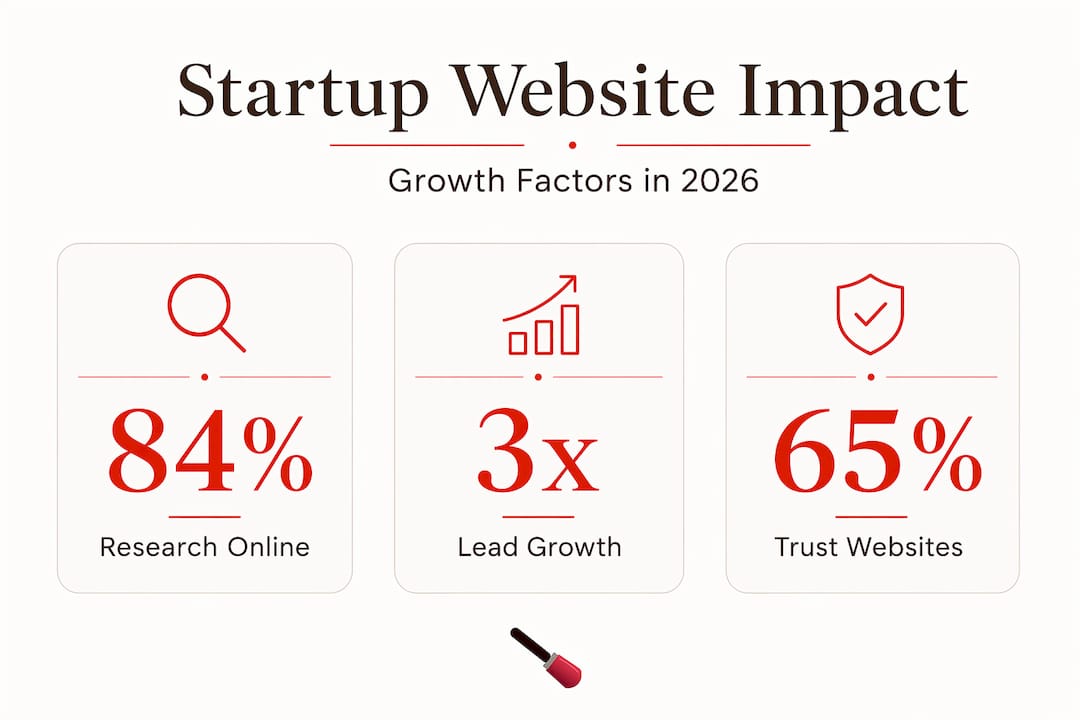
| First impressions are digital | Over 80% of customers research online first, making your website the most critical early touchpoint. |
| Messaging beats design | Clear answers to what, who, and why convert better than visually impressive but vague sites. |
| Platform choice has long-term costs | Choosing a builder for speed alone leads to expensive migrations as your startup scales. |
| SEO is a compounding asset | Content built around real search intent reduces customer acquisition costs over time. |
| Iterate fast, not perfectly | Startups that update sites based on customer signals outperform those waiting for a perfect version. |
How websites support startup growth from day one
Most founders spend months perfecting their product and then throw together a website in a weekend. That sequence is backwards. Over 80% of customers perform online research before making any buying decision or visiting a physical location. That means your website is doing sales work before your team even picks up the phone.
The importance of websites for startups goes beyond visibility. A well-built site validates your credibility to three distinct audiences at once: potential customers who need to trust you before spending money, investors who are quietly assessing your operational maturity, and potential partners or hires who want to know you are serious. A placeholder page with a logo and a contact form tells all three groups the same thing: you are not ready.
Digital branding and clear messaging also do measurable conversion work. When a visitor lands on your site and immediately understands what you do, who it is for, and why it matters, they stay. When they have to work to figure it out, they leave. That bounce rate is not just a vanity metric. It is lost revenue and a signal that your messaging is not doing its job.
Here is what a growth-ready website does from the start:
- Communicates your value proposition in the first five seconds
- Builds trust through social proof, clear design, and professional presentation
- Captures leads with specific, low-friction calls to action
- Signals operational credibility to investors and partners
- Provides a foundation for SEO and content marketing to build on
Website messaging that actually converts
The single biggest mistake founders make with their websites is writing for themselves instead of their customers. Technical founders especially fall into this trap. They describe their product using the language they use internally, and visitors who have never heard those terms leave confused.
Effective startup websites answer three questions immediately using the customer's own language: What is this? Who is it for? Why should I care right now? If a visitor has to scroll past your hero section to find the answer to any of those questions, your messaging needs work.
Simple navigation matters more than creative navigation. Founders sometimes try to be original with their menu structure, but visitors expect conventions. They look for a product or services page, an about page, and a contact or pricing page. Subverting those expectations creates friction, and friction kills conversions.
Pro Tip: Write your homepage headline by finishing this sentence: "We help [specific person] do [specific thing] so they can [specific outcome]." It sounds formulaic because it works. Clarity converts.
Clear calls to action are non-negotiable. Every page should have one primary action you want the visitor to take. Not three. Not five. One. Whether that is booking a demo, signing up for a free trial, or downloading a guide, the path forward should be obvious and repeated at logical intervals down the page.
The balance between design and messaging is worth addressing directly. A beautiful site with vague copy will underperform a plain site with sharp, specific messaging. Design supports trust. Messaging drives decisions. You need both, but if you have to prioritize one in early stages, write better copy first.
Choosing the right platform for scalable growth
Platform selection is one of the most consequential early decisions you will make for your website, and most founders get it wrong because they optimize for the wrong variable. Speed to launch feels urgent. Scalability feels abstract. But choosing a builder based only on quick launch speed without considering integrations and scalability leads to costly platform migrations down the line.
Here is a practical comparison of what to weigh at different startup stages:
| Factor | Early stage priority | Growth stage priority |
|---|---|---|
| Launch speed | High | Low |
| SEO control | Medium | High |
| Custom integrations | Low | High |
| Branding flexibility | Medium | High |
| Cost per month | Low | Acceptable |
| Developer access | Optional | Required |
Free plans on popular website builders are fine for validating an idea. The moment you are serious about SEO, custom branding, or connecting your site to a CRM or analytics stack, a free plan becomes a ceiling. Upgrading is not just about features. It signals to your team and your market that you are operating like a real business.
Website performance metrics like uptime and load speed directly correlate with conversion rates and user engagement. A site that loads in under two seconds converts measurably better than one that takes four. This is not a minor technical detail. It is a revenue variable.
Pro Tip: Before committing to any platform, test whether it can connect to the tools you plan to use in 12 months: your email platform, CRM, analytics, and payment processor. A platform that cannot support those connections will cost you far more to migrate from than it saved you to start with.
Managed cloud hosting enables startups to scale infrastructure without needing a dedicated DevOps hire. For most early-stage startups, this is the right call. You want your engineering attention on your product, not on server uptime.
Founders should select platforms aligned with their startup stage rather than defaulting to whatever is most popular or cheapest. The right platform at seed stage is not necessarily the right platform at Series A.
Content and SEO as a long-term growth engine
Paid ads stop working the moment you stop paying. SEO does not. That asymmetry is why content strategy is one of the most effective ways to understand how websites boost startups over a multi-year horizon.

Startups using SEO-focused content marketing see higher organic traffic and more predictable lead generation compared to simple placeholder sites. The mechanism is straightforward: when you publish content that answers the questions your customers are already searching for, you attract visitors who are already primed to care about what you offer.
Here is a practical sequence for building content that supports startup growth:
- Identify your customers' real questions. Use tools like Google Search Console or even Reddit threads in your niche to find what people actually type into search engines. Build content around those exact queries.
- Start with niche, specific topics. A post titled "How B2B SaaS founders reduce churn in the first 90 days" will outrank a generic post about churn every time. Specificity wins in search.
- Write case studies early. Even one customer success story, told in detail, builds trust and ranks for problem-aware search terms.
- Address technical SEO fundamentals. Page titles, meta descriptions, header structure, and internal linking are not optional extras. They are the foundation that makes your content findable.
- Align content with the customer journey. Awareness-stage content (what is this problem?) and decision-stage content (why choose us?) serve different purposes. You need both.
SEO supports discipline in messaging and content structure that aligns with real user search behaviors, creating a long-term visibility asset. That discipline also forces clarity. When you write for a specific search query, you cannot be vague. That rigor improves your overall messaging.
Maintaining your website as a living growth asset
Shipping your website is not the finish line. It is the starting gun. The founders who treat their site as a fixed deliverable and move on are the ones who wonder why their conversion rates plateau six months later.
Startups that iterate their websites quickly based on customer insights gain agility and better conversion performance compared to those delaying updates. The practical implication: build a site you can change without calling a developer every time.
Here is what a healthy website maintenance rhythm looks like for a growing startup:
- Review your analytics monthly. Look for pages with high traffic and low conversions. That gap is your opportunity.
- Update your homepage messaging whenever your positioning evolves. Your site should reflect how you describe your product today, not how you described it at launch.
- Add new customer proof regularly. Fresh testimonials, case studies, and logos signal that your business is active and growing.
- Test one change at a time. Changing your headline and your CTA button simultaneously tells you nothing about what worked.
Pro Tip: Set a calendar reminder every 90 days to read your own homepage as if you were a first-time visitor. Ask yourself: "Would I understand what this company does in 10 seconds?" If the answer is no, rewrite before you do anything else.
The goal is founder-controlled agility. When you can update your own site without a development ticket, you move faster than competitors who are waiting on an agency. That speed compounds.
My honest take on what founders get wrong
I've seen hundreds of startups treat their website as an afterthought, something to check off the list before they get back to "real work." That thinking is one of the most expensive mistakes a founder can make.
In my experience, the website is where your entire narrative either lands or falls apart. Investors who are considering you will visit your site before they take your call. What they find there tells them whether you understand your market, whether you can communicate clearly, and whether you sweat the details. Slow or cluttered sites send a negative silent signal that affects investor and customer trust before any direct interaction. That signal is hard to undo.
What I've learned is that clarity and speed of iteration beat polish every single time in the early stages. A founder who ships a clear, fast, honest website on day one and updates it every two weeks will outperform a founder who spends four months building something beautiful but vague. The subtle cues a website sends through technical performance and messaging quality affect how mature and credible your operation appears. You cannot fake that with a nice color palette.
My advice: launch something real, watch how people respond, and change it fast. Your website is not a monument. It is a conversation.
— AngryZZen
Build your startup website the right way
If you have read this far, you understand that effective websites for business growth are not accidents. They are built with intention, from the platform choice to the copy to the technical foundation underneath.
Thomasdesigns takes a different approach to startup websites. Every site is hand-coded from scratch in HTML, CSS, and JavaScript by a single developer who gives your project real attention, not a template and an algorithm. That means your site is fast, clean, and built to scale without the migration headaches that come from outgrowing a drag-and-drop builder. Post-launch support includes daily updates and ongoing promotion at no extra cost. If you are ready to build a website that actually works as a growth asset, explore what Thomasdesigns can do for your startup.
FAQ
How do websites support startup growth?
Websites support startup growth by building credibility, capturing leads, and creating a foundation for SEO-driven organic traffic. They serve as the primary trust signal for customers, investors, and partners before any direct contact occurs.
Can a website grow my startup without paid advertising?
Yes. Through SEO-focused content marketing, startups can attract targeted organic traffic that compounds over time, reducing dependence on paid channels and lowering customer acquisition costs.
What is the most important element of a startup website?
Clear messaging that answers what you do, who it is for, and why it matters within the first five seconds. Design supports trust, but messaging drives the decision to stay or leave.
When should a startup upgrade from a free website builder?
The moment you need custom branding, SEO control, or integrations with tools like a CRM or analytics platform. Staying on a free plan past that point limits growth and often leads to costly migrations later.
How often should a startup update its website?
At minimum, review your homepage messaging and analytics every 90 days. Update copy whenever your positioning shifts, and add new customer proof regularly to signal that your business is active and growing.